Integrated marketing · Growth systems
Build a Full-Funnel Growth System Without Diluting the Brand
A full-funnel growth system connects one audience problem, one promise, one journey and one definition of progress across every channel. Brand is not diluted when each touchpoint expresses the same strategic decision appropriately.
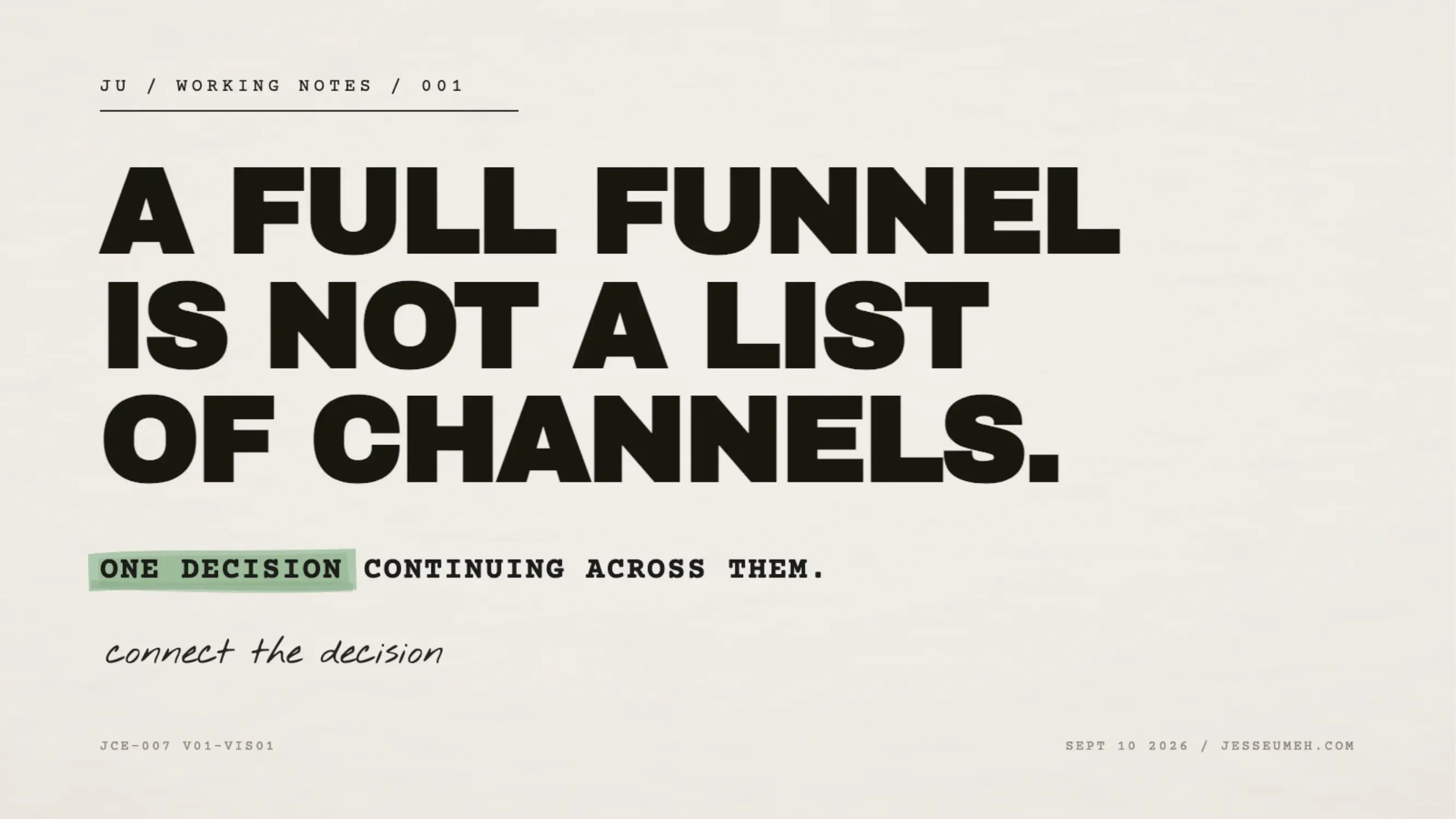
A full funnel is not a list of channels.
It is one audience decision continuing across every interaction.
A company can run paid media, organic social, email, events, a website, sales follow-up and reporting—and still make the customer restart the journey at every step. Each channel may be active. Each team may be producing. But the experience does not compound because the strategy changes as the audience moves.
That is the difference between channel coverage and a connected growth system.
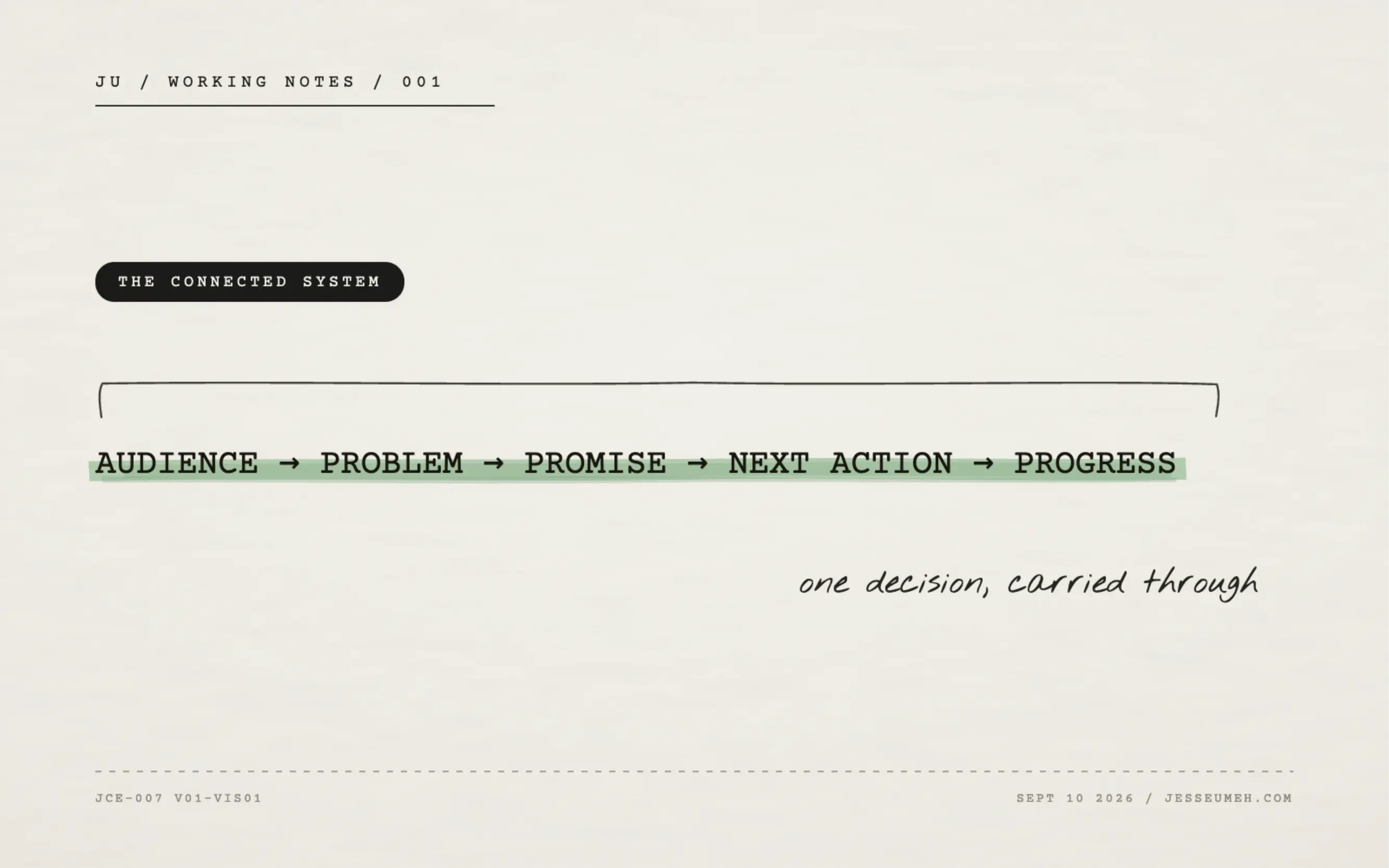
A connected system aligns five decisions:
- Who the priority audience is
- What problem matters most to them
- What promise the brand can credibly make
- What action should come next
- What evidence defines progress
When those decisions remain stable, the expression can change by channel without diluting the brand.
Brand consistency is not repetition
Teams often protect brand consistency by repeating the same headline, visual or campaign asset everywhere.
That can create recognition. It does not automatically create relevance.
The job of an ad is different from the job of a landing page. The job of a landing page is different from the job of email follow-up. The job of a sales or enrollment conversation is different again.
Consistency does not require every touchpoint to say the same thing in the same way.
It requires every touchpoint to advance the same promise.
The brand provides the meaning. The funnel organizes how that meaning becomes action.
Start with one audience decision
Before selecting channels, define the decision the audience needs to make.
Not the asset the team wants to produce.
Not the platform that needs content.
Not the tactic that performed well last quarter.
The decision might be:
- This organization understands my problem.
- This offer is relevant to my situation.
- This approach is credible.
- The next step feels worth the effort.
- I am ready to speak with someone.
Once the decision is clear, each channel can help the audience move toward it.
Without that clarity, teams optimize disconnected outputs.
Every metric may improve while the complete journey remains weak.
Connect the promise before connecting the platforms
Technical integrations matter, but a connected technology stack cannot repair a disconnected promise.
Start with the message.
Ask:
- What are we promising?
- What evidence makes that promise believable?
- What question must be answered at this stage?
- What friction could prevent the next action?
- What should the next touchpoint already know?
The answers create continuity.
An ad should not make a promise the landing page cannot explain.
The landing page should not request an action the follow-up cannot support.
The follow-up should not ignore the interest or context the audience already provided.
The final conversation should not introduce a completely different reason to believe.
The customer should feel that one organization is paying attention—not that several teams are handing them unrelated messages.
Use one operating brief across the journey
A connected funnel needs a shared source of direction.
The brief should define:
- Primary audience
- Audience problem
- Core promise
- Required proof
- Desired next action
- Journey stages
- Channel roles
- Measurement hierarchy
- Ownership and handoffs
This does not mean every team loses its expertise.
It means every specialist is solving the same assignment.
Creative can translate the promise.
Media can find the right audience.
Web can reduce friction.
Lifecycle teams can continue the conversation.
Sales or enrollment can use the context.
Analytics can measure movement across the system.
The brief becomes an operating agreement, not a document that disappears after kickoff.
Give every channel a specific job
Channels become more effective when their roles are defined by the customer journey rather than by an internal content calendar.
A simple model is:
1. Create recognition
Help the right audience recognize the problem, tension or opportunity.
2. Build understanding
Explain the distinction, mechanism or point of view that makes the brand useful.
3. Establish confidence
Provide evidence, examples, answers and proof appropriate to the decision.
4. Make action easier
Reduce friction and make the next step proportionate to the audience’s readiness.
5. Continue the relationship
Use the context already earned to make follow-up more relevant.
A channel may support more than one job, but it should not be expected to perform every job at once.
Measure progression, not isolated activity
A full-funnel system needs channel metrics. It also needs a measurement hierarchy.
Start with the business or audience outcome.
Then identify the behaviors that signal movement toward it.
Then use channel metrics as diagnostics.
For example:
- Business outcome: qualified conversation
- Progress signal: completed case study, return visit or form start
- Channel diagnostic: click-through rate, landing-page engagement or email response
This prevents a strong local metric from being mistaken for a strong system.
For an education example, the Expanded Learning Growth Framework traces campaign actions through enrollment, participation and measurable program impact.
It also protects the brand from short-term tactics that generate activity while weakening trust.
Revenue language requires the same discipline. Influenced revenue is not the same as directly attributed revenue. Assisted movement is not the same as sole causation. Clear definitions make the work more credible and the decisions more useful.
Build the system in five steps
Step 1: Diagnose the break
Map the current journey from first exposure through follow-up. Identify where the audience encounters a changed promise, repeated question, missing context or unclear next action.
Step 2: Align the five decisions
Confirm the audience, problem, promise, next action and definition of progress.
Step 3: Assign channel roles
Define what each touchpoint must help the audience understand, believe or do.
Step 4: Repair the handoffs
Make sure information, expectations and context continue between teams and platforms.
Step 5: Review the system together
Bring brand, creative, media, web, lifecycle, sales and analytics into the same performance conversation. Ask where the journey improved—not only which channel won.
The goal is coordinated growth
Brand and performance are not opposing systems.
Brand creates meaning, memory and trust.
Performance helps that meaning reach the right person and move toward action.
The funnel connects the two.
The goal is not to make every channel identical.
The goal is to make every channel coherent.
When the audience can move from recognition to understanding, confidence and action without losing the promise, the brand is not being diluted.
It is being experienced as a system.
A practical next step
Before adding another tactic, review one active campaign and answer:
- Is every channel serving the same priority audience?
- Does the core promise remain consistent?
- Is each touchpoint answering the right question for its stage?
- Does context carry into the next interaction?
- Are we measuring progression or isolated activity?
The first “no” is probably a better place to invest than the next channel.
Share where the journey is breaking.