Integrated marketing · Operating model
Why Brand and Growth Break When Managed Separately
Brand and growth break when each team optimizes a different audience, promise, journey or measurement timeline. The fix is not a universal budget split. It is one shared operating system that connects demand creation and demand capture.
Brand and growth are not opposing strategies. They solve different parts of the same business problem.
Brand creates the conditions that make demand more likely: clarity, recognition, memory, trust and preference.
Growth turns available demand into movement: reach, response, conversion, learning and revenue.
That distinction is useful, but it is not a rigid channel taxonomy. A channel commonly labeled “brand” can create immediate response. A channel labeled “performance” can shape future memory. The real question is not which team or channel gets credit. It is whether the entire system helps the right audience choose and act.
When brand and growth are managed separately, each side can look productive while the business remains fragmented. Brand may earn attention without a clear path to action. Performance may optimize response without strengthening the reason someone should choose the organization in the first place.
The result is activity without compounding.
The false choice between brand and performance
Many planning conversations start too late. They begin with a budget split, a channel plan or a debate about whether the next investment should build the brand or generate leads.
Those are important decisions, but they are downstream decisions.
The first question is: what business problem must marketing help solve?
If the problem is unclear, brand and performance teams build different answers.
One team defines success as stronger awareness or affinity. Another defines it as lower acquisition cost or more conversions. Neither is necessarily wrong. The failure is that the goals, audience and time horizon were never connected.
Current effectiveness research makes the old binary harder to defend. Thinkbox’s Profit Ability 2 study analyzed econometric work from 141 brands covering £1.8 billion in media spend. It found that immediate payback was not exclusive to so-called performance media and that sustained effects materially changed the full return picture.
The Institute of Practitioners in Advertising continues to show the value of balancing brand building and activation across its dataset. Its broad benchmark is useful as a planning reference, not a universal prescription for every organization, category or budget.
The operating lesson is more durable than any single ratio: businesses need both demand creation and demand capture, measured on the timelines where each can reasonably work.
Four fractures created by separate systems
1. The teams build for different audiences
Brand work often starts with a broad customer or community definition. Performance work often starts with a targetable segment.
If those two views are not reconciled, the organization speaks one language publicly and another language at the point of conversion.
A shared audience truth should answer:
- Who matters most for this business problem?
- What are they trying to accomplish?
- What tension keeps them from moving?
- What evidence will make the promise believable?
- What action is realistic next?
Targeting can become more specific by channel. The human problem should remain recognizable across the system.
2. Creative carries different promises
Brand creative may emphasize identity, emotion or distinctiveness. Performance creative may emphasize urgency, proof or an offer.
Those are not incompatible. The problem appears when they feel like two unrelated organizations.
Creative should flex by job while preserving the same strategic center:
- one positioning
- one primary promise
- recognizable evidence
- a consistent reason to choose
- a next step proportionate to the audience’s readiness
Consistency does not mean repeating the same asset everywhere. It means every expression reinforces the same meaning.
3. The journey breaks between attention and action
A campaign can generate interest and still fail because the next step does not continue the promise.
Every handoff creates a chance for demand to leak.
The next step is to carry that same promise through the whole journey. See how to build a full-funnel growth system without diluting the brand.
An integrated system maps the path before production:
ATTENTION → UNDERSTANDING → TRUST → ACTION → FOLLOW-THROUGH
Each stage should answer the next question the audience is likely to have. That is how brand meaning becomes a growth path rather than a layer of polish placed above it.
4. Measurement rewards the wrong time horizon
Immediate response matters. So do effects that accumulate beyond the reporting window.
If every investment is judged within the shortest conversion cycle, the system will favor what is easiest to count now. If brand work is never connected to a business outcome, it can become protected from useful accountability.
Both extremes are avoidable.
Immediate
Response, qualified traffic, conversion, cost and learning within the active decision window.
Sustained
Branded demand, direct and organic traffic, consideration, conversion quality, repeat behavior and profit over an appropriate longer period.
The exact measures depend on the business model. The discipline is to define the expected job and timeframe before the campaign launches.
The Brand-to-Growth Operating System
Connecting brand and growth does not require collapsing every role into one team. It requires shared decisions.
1. One business problem
State the outcome marketing must influence and the constraint preventing it.
“Create a campaign” is not the problem.
“Increase qualified demand among a defined audience without weakening the brand’s premium position” is closer.
2. One audience truth
Agree on the audience’s job, tension, current belief and decision barrier before channel segmentation begins.
3. One strategic promise
Define what the organization can credibly promise, why it matters and what proof supports it.
4. One connected journey
Design the path from first exposure through conversion and follow-through. Give each channel a job within that path.
5. Two measurement clocks
Track immediate response and sustained growth without pretending they are the same event or granting either side immunity from accountability.
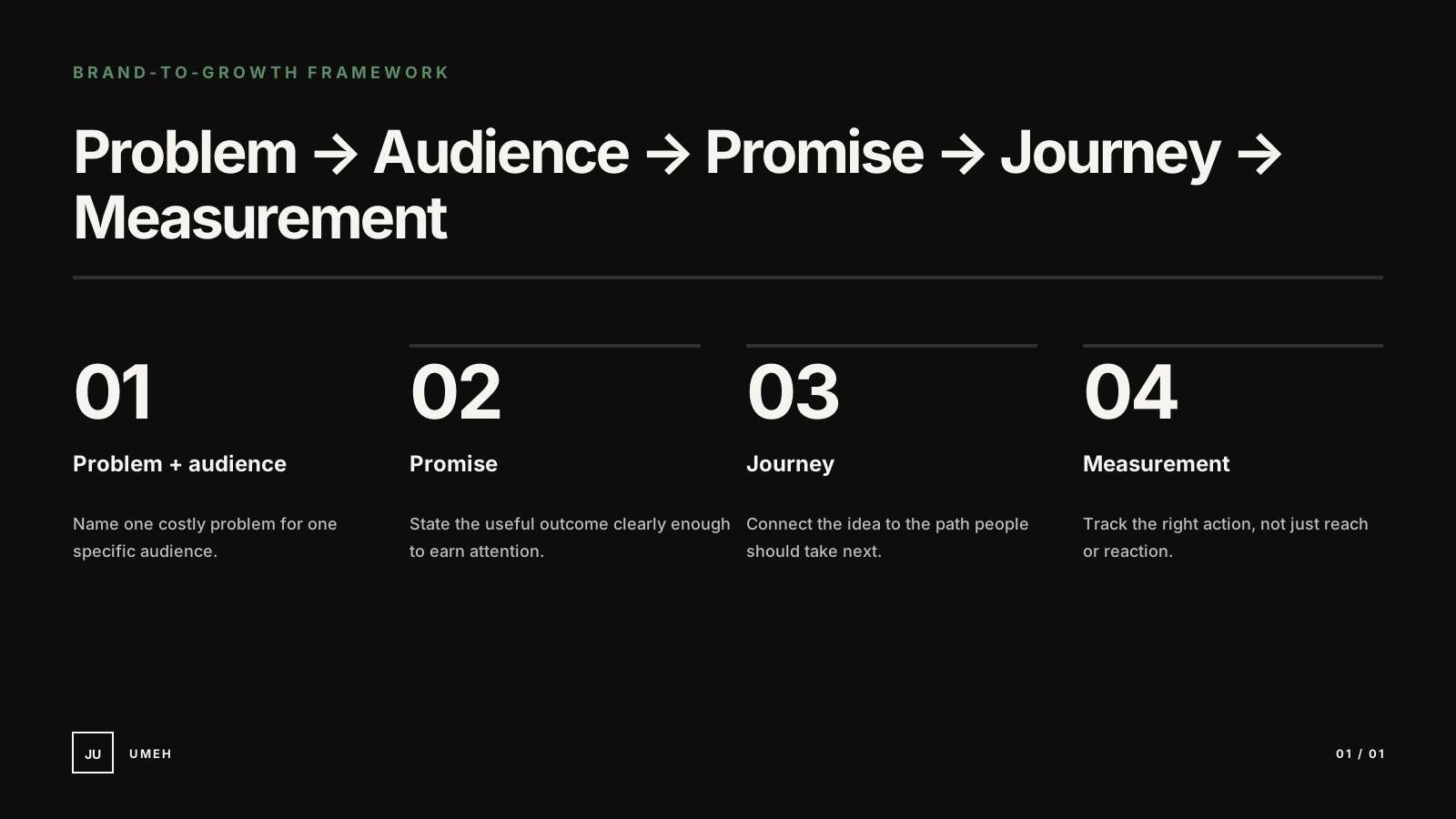
This creates a more useful planning sequence:
PROBLEM → AUDIENCE → PROMISE → JOURNEY → MEASUREMENT → CHANNELS → ASSETS
Most fragmented systems begin at the opposite end. They start with the assets or channels and attempt to reverse-engineer coherence later.
A practical diagnostic for leaders
Before approving the next campaign, ask:
- Can every team describe the same business problem?
- Are brand and performance working from the same audience truth?
- Does every channel reinforce the same strategic promise?
- Does the next step continue the expectation created by the message?
- Are immediate and sustained effects measured on appropriate timelines?
- Is one leader accountable for the integrity of the full system?
If the answers conflict, the organization does not need more activity yet. It needs clarity.
Working through one of these fractures now? Share the one creating the most drag.The point is not balance. It is connection.
There is no universal brand-to-performance split that replaces judgment.
Budgets, channels and timelines should change with category, maturity, economics, audience and evidence. The operating principle should not:
Brand and growth must work from one shared system.
Brand gives demand meaning.
Growth gives demand a path.
Measurement gives the organization a way to learn.
When those three functions reinforce one another, marketing stops behaving like a collection of outputs and starts becoming a system that can compound.