AI leverage · Positioning · Creative leadership
Why AI Cannot Rescue Unclear Positioning
AI can accelerate research, variation and production. It cannot decide who a brand should prioritize, what promise it can credibly own or which tradeoffs leadership is willing to make.
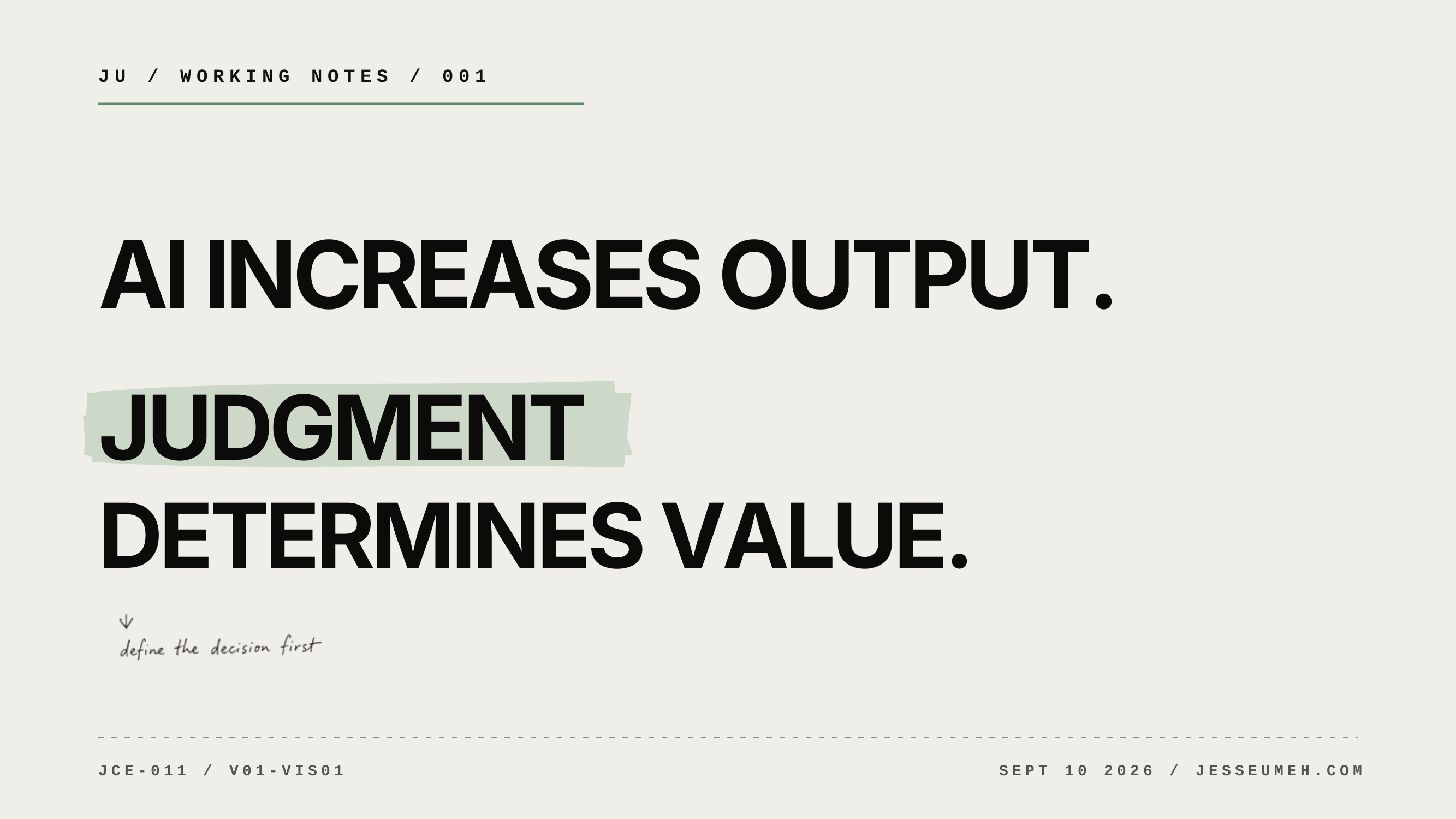
AI can accelerate marketing production.
It cannot decide who a brand should prioritize, what promise it can credibly own or which tradeoffs leadership is willing to make.
If those choices remain unresolved, AI does not remove the confusion. It gives the confusion more ways to express itself.
That distinction matters as marketing teams use AI to produce research summaries, concepts, headlines, campaign variations, personalized journeys and channel assets at increasing speed.
The productivity opportunity is real. McKinsey has estimated that generative AI could create productivity value equal to 5–15% of total marketing spending. Its more recent marketing analysis describes AI capabilities expanding across insight development, creativity, personalization, agentic commerce and optimization.
But production leverage and strategic clarity are different assets.
A team can produce more and still become less recognizable.
AI is a force multiplier—not a source of positioning
Positioning requires decisions.
A business must decide which audience matters most, which problem it is equipped to solve, what alternatives it should be compared against, what promise it can support and what it is willing not to be.
AI can help examine those decisions. It can organize research, surface patterns, create alternatives and pressure-test assumptions.
It cannot take responsibility for the choice.
That responsibility remains with leadership because positioning is not simply a language problem. It affects product priorities, customer expectations, creative direction, channel strategy, sales conversations and the evidence the organization must produce.
When that shared direction is missing, brand and growth can break into separate systems even before AI enters the workflow.
When a team asks AI to “make the brand sound stronger” before those decisions exist, the tool has to fill the gaps.
The result may be polished.
It may also be strategically interchangeable with everyone else.
Unclear positioning becomes faster sameness
Generic AI output is often treated as a prompting problem.
Sometimes it is.
But the deeper problem is frequently the absence of meaningful constraints.
The visible symptom is generic content.
The operating problem is that the organization has not made the decisions the content needs to carry.
Google’s guidance reflects a related principle: generative AI can be useful for research and adding structure, but producing large amounts of content without adding meaningful value does not become helpful merely because it is efficient. LinkedIn’s current guidance similarly emphasizes original, educational and credible expert content rather than treating AI-assisted volume as a substitute for authority.
Speed cannot create a point of view that leadership has not defined.
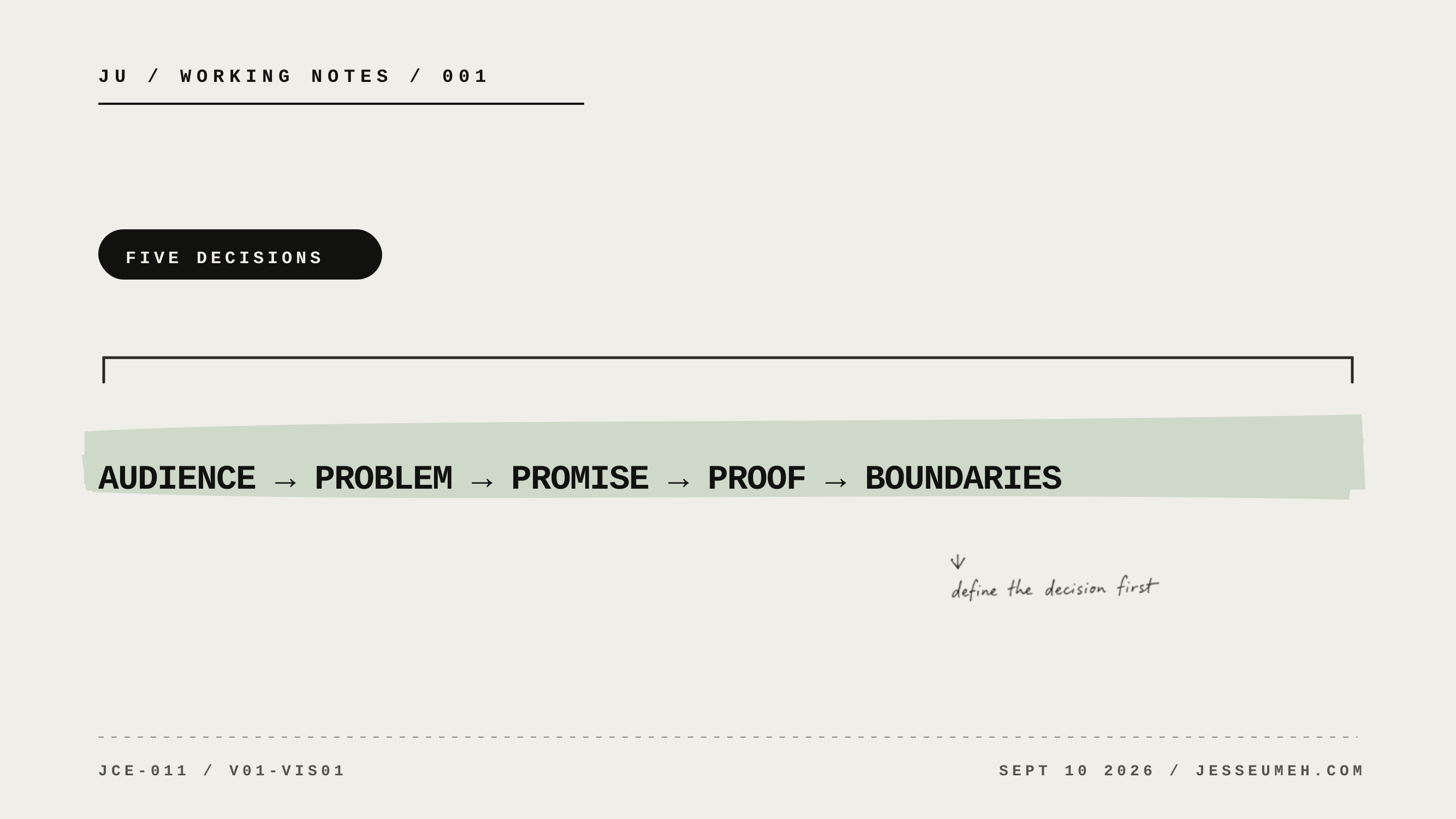
Five decisions to align before AI enters production
Before using AI to scale a campaign, content system or customer journey, align five things.
1. Audience
Who is the primary person or buying group the work must help?
Not every possible customer. Not a list of personas with equal priority. The decision must be specific enough to guide what matters, what can be omitted and which language will be understood.
2. Problem
What business or human problem deserves attention now?
A product feature is not automatically the problem. Neither is a channel objective. The team needs a shared definition of the tension the audience recognizes and the consequence of leaving it unresolved.
3. Promise
What should the audience understand, believe or expect after encountering the work?
The promise should connect the problem to a meaningful outcome without claiming more than the organization can deliver.
4. Proof
What evidence makes the promise credible?
Proof may include a mechanism, relevant experience, research, an artifact, a case result or a transparent limitation. AI can help organize proof. It cannot invent permission, causality or credibility.
5. Boundaries
What must the work not become?
Define the claims the brand cannot make, the audiences it is not prioritizing, the voice it will not adopt and the creative choices that would undermine trust.
Boundaries are not unnecessary restrictions. They are part of what gives AI useful direction.
Where AI creates meaningful leverage
Once the strategic decisions are clear, AI becomes far more valuable.
It can help a team:
- Synthesize customer, competitor and market research
- Generate several expressions of one approved strategy
- Adapt a message across channels without losing the central promise
- Pressure-test assumptions and reveal missing questions
- Identify inconsistency across briefs, pages and campaign assets
- Reduce repetitive production work
- Create a broader option set for experienced leaders to evaluate
McKinsey’s work on AI-assisted strategy makes the same underlying distinction: AI can operate as a thought partner and help challenge plans, but that does not remove the need for human objectives, judgment and accountability.
The best use of AI is not asking it to decide what the organization has avoided deciding.
It is using AI to increase the leverage of decisions leadership has made well.
The leadership work becomes more important
As production becomes easier, judgment becomes more valuable.
Marketing leaders still have to define what good looks like, determine which evidence matters, protect the brand from convenient overclaims and decide which option deserves to move forward.
The question is no longer whether a team can produce enough.
The harder question is whether all that production carries one recognizable strategy.
Before asking AI for more output, ask whether the organization has given it clear decisions to amplify.
AI can expand the option set.
Judgment determines which option deserves to exist.
Sources and limitations
- McKinsey: The economic potential of generative AIThe 5–15% figure is an economic-potential estimate, not a guarantee for an individual team.
- McKinsey: From campaigns to continuous growthA strategic capability framework; it does not establish that AI independently creates positioning clarity.
- Google Search Central: Guidance on generative AI contentSearch-quality guidance rather than an experimental study of brand positioning.
- LinkedIn: AI visibility in 2026Current platform guidance and internal observations; platform behavior may change.
- McKinsey: How AI is transforming strategy developmentStrategic guidance; leaders remain responsible for objectives, evidence and choices.